
我们刚刚开始开发这个项目,该项目基于我们对纺织品和文化遗产问题的共同兴趣。
与 Aba Eyifa Dzidzienyo 博士合作
近年来,纺织品领域出现了一股新的风潮,工艺行动主义和带有社会行动主义色彩的纺织品越来越受到关注。这种情况在欧洲和美洲尤为突出,然而,人们对非洲的刺绣艺术却知之甚少。
我们的项目将我们对纺织品的兴趣结合起来,旨在探索加纳境外博物馆库房中不同类型的非洲或加纳纺织品。
近二十年来,纺织工艺和针线活项目有了显著增长。
1. 我们一直在研究博物馆收藏的非洲纺织品。
2. 我们也对非洲艺术家使用纺织品的情况很感兴趣。
3. 我们也对纺织品的来源感兴趣。英国的藏品中有哪些加纳纺织品?它们是如何获得的?
当代非洲是否有缝纫团体或纺织艺术家利用织物艺术进行社会活动、纪念活动或社会变革?
哪些非洲艺术家从事纺织品创作?其中有加纳艺术家吗?
我们迄今为止的合作
We started our project exploring the displays in local museums such as the Cambridge Museum of Anthropology and Archaeology.
We looked at the Asante gold in MAA
and reflected on the acknowledgement of some of the items that have been looted.
There are some textiles in the MAA that appear to be looted. But not all are looted, and I think there is rich and vibrant research to be done on the contributions from Cambridge Anthropologists.
Not all Ashanti items were looted
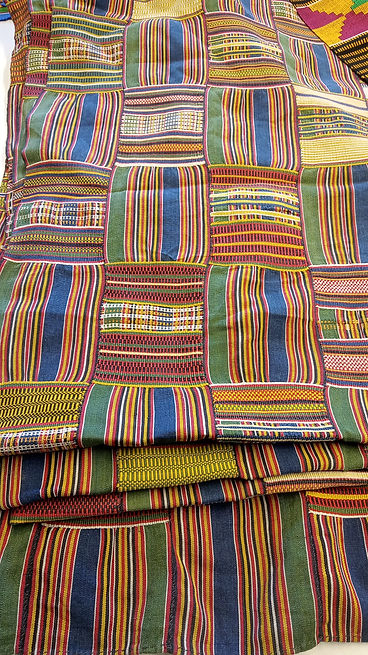
We are interested in a royal robe, made from strip woven fabric in yellow, red, blue and black that was donated in 1934. It is comprised of checks and stripes and is embroidered with Kente design.
The museum says that it has letters in the collection from Gow to Clarke discussing Asante items (a stool, a chair and the robe). These were given to his maternal grandparents by the Rev. Tregaskis, general superintendent of the Wesleyan missions in West Africa. Tregaskis is noted as the tutor of "Prince John Ossoo Ansah, maternal uncle of King Cofee (or Kofi) of Ashanti", who had been "driven out of Cape Coast Castle where he was living by Fantees who were afraid of an Ashanti invasion. Both Prince Ossoo Ansah and Tregaskis had stayed with Gow's mother's parents in 1874, with Tregaskis giving them these gift in return for their hospitality.
------ o ------
On the 19th January 2024 Aba and I visited the Pitt River Museum.
The textiles repository was in the process of being moved to a new storage facility beside the museum and so we were not able to access textiles that were not on display.
In the morning we met with Lennon Mhishi, who explained some of the work being done by the Pitt Rivers museum to engage the public with the collections. Mhishi is working with art students from Central St Martins in London, who create artworks in response to objects from the Africa collection. We spoke about the looted items and he explained that with the items, knowledge systems were lost, since knowledge was often passed on in ceremonies that used the object.
In the afternoon we looked at a box of Asanti gold weights (Number 1949.7.3-). The provenance records for these items state that they were collected by Major C.H.W. Donovan (a founding member of the Army Service Corps) during the Ashanti war of 1896. (Photo of book).
Online records from give further information “Captain R. R. Donovan brought us carvings from King Prempeh’s palace, collected by Major C. H. W. Donovan during the Ashanti War of 1896, and other Ashanti material.”
16. Report of the Curator of the Pitt Rivers Museum (Department of Ethnology) for the year ending 31 July 1949.
I was impressed by the amount of work that has been done by the museum to make these reports available digitally, which means they can be researched from the African continent.
We also met a curator in the public engagement who brought out a box of African textiles that is in the object handling collection. These textiles would be taken to schools and used with school groups in the museum.
Back in Cambridge, Aba gave a talk on restitution in Murray Edwards College.
In terms of textiles existing provenance research says that they tend to have come in three ways, missionary, looting, and anthropological.
I have become interested in those textiles that were donated by academics.
The second strand of our project is to reflect on contemporary African textile art. With that in mind, Aba and I visited the Tate Turbine hall where we enjoyed El Anatsui BEHIND THE RED MOON
Which is actually made from bottle tops that were sourced in Nigeria.
It is a monumental textile sculptural installation that reflects on colonial trade routes, the history of transatlantic commerce and the trade in enslaved people.

